
Foundation: four noble truths

1
Dukkha

2
Tanha


3
Nirodha
4
MAgga
Truth One: Dukkha
Explanation:
All humans suffer and experience pain. A deer limps when struck, a bird cries when its wing is broken, an elephant mourns the loss of its calf. But the first noble truth of suffering, what Buddhists call dukkha, could be uniquely human. It is not only the physical ache of pain but the emotional anguish we create when we weave stories around it.
Pain is inevitable; it comes with life. But suffering . . . could that be a choice for us as humans? When we layer judgment, blame, shame, or fear on top of pain, we move from what is real into the realm of stories. These stories are powerful. They can keep us trapped for decades or free us in an instant. I call the suffering that has been passed down from generation to generation “Family DNA Karma.”
The first step in the NobleHuman journey, and the one we also took first during the Alpha Tribe, is to understand what your suffering is and where it came from by examining your Family DNA Karma. What stories have your ancestors and family been telling you? What stories have you accepted as yours? What are your drivers derived from your suffering? What are your hard-wired sufferings? What emotions are embedded in your DNA that you want less of?
Exercise:
Step One
Complete the questions below on the lines provided or use a favorite journal for further reflection. You can also use a Word or Excel document. You can write a short sentence/paragraph or a novel for each question that follows:
Section 1: Opening Reflections – Identity and Inheritance
Out of your mother(s)/mother figure(s) and father(s)/father figure(s) (could be grandparents, step parents, etc.), whom do you most resemble in appearance and personality? What are their names and current ages?
What do you love about their physical or personality traits you inherited from them?
What do you find challenging about the traits you inherited?
How have those traits shaped the way you show up in the world?
How do others see you, and how is that different from how you see yourself?
Section 2: Generational Influence – Family Origins and Patterns
What were your mother’s and father’s parents like? What are their names and current ages?
How do you think your grandparents treated your parents? What do you think your parents internalize or reject from them? Have you talked to your parents about their relationship with your grandparents and your parents’ feelings towards them?
How did your parents treat you? What do you believe shaped their parenting style?
What values or wounds have passed down through your family line?
Section 3: Siblings and Social Belonging
Who were your siblings, and how were they similar or different from you? What are their names and current ages?
How did your parents treat them compared to you?
What was your relationship like with your siblings growing up, and how is it now?
Who were your best friends during childhood? What are their names and current ages? What were their personality traits?
What did you cherish most about your time with them?
Were there moments when you felt left out, bullied, or scared in social situations? What memories stand out? What are their names and current ages?
Section 4: Inner World – Childhood Dreams, Fears, and Loss of Agency
When you were a child, what did you dream of becoming? Why?
What were you most afraid of as a child?
What were you forced to do that you didn’t want to do?
What did you need most that you didn’t receive?
Section 5: Achievement and the Cost of Success
What have been your primary internal drivers in life? What has fueled your ambition?
What moments in your life have defined your sense of success or failure?
What are you still trying to prove? To whom?
What patterns or traits helped you succeed but no longer serve you?
What characteristics or habits would you rather stop cultivating?
What kind of suffering do you hide the most?
Step Two
Once you’ve completed the preceding reflection questions, take time to synthesize what you’ve uncovered. Now, write who you most resemble from your family (mother, father, grandparents), physically, then in personality traits. Then identify your positive and negative drivers, and reflect on where they originated.
Step Three
Write a short narrative (1–2 paragraphs) that expresses your personal dukkha, the deep patterns, beliefs, or emotional burdens that have shaped your life. Reflect on the following:
What negative drivers have fueled your success but are no longer serving you?
What emotional wounds or inherited patterns have held you back from living your best, most authentic life filled with joy?
Where have you sacrificed peace, freedom, or joy in pursuit of achievement or approval?
Go beneath surface level. Several layers deeper. This is your opportunity to gain clarity with compassion, so that you can begin the process of releasing what’s been blocking you. You're welcome to collaborate with your favorite AI to examine where you are during each step. You might be surprised at what AI will help you discover about yourself and suffering.
Step Four
Johari Window
As you now know, we are often shaped by our Family DNA Karma, environment, negative bias, and cultural expectations. The Johari Window is a leadership tool used to enhance self-awareness, improve team dynamics, and support effective communication and was developed by Joseph Luft and Harrington Ingham in 1955. . It is divided into four quadrants, as shown in the following figure. The goal is to expand your open area to foster deeper trust, collaboration, and personal growth.
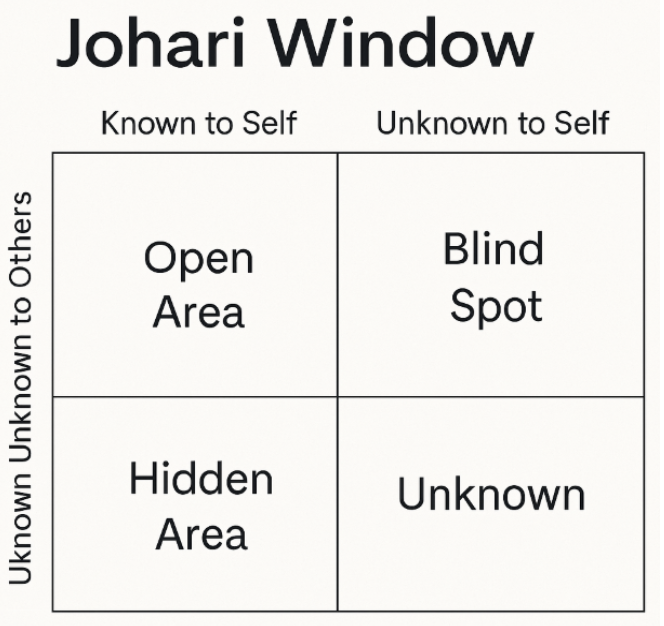
The goal is to uncover our Blind Spots as we build deeper understanding with one another.
If you need further clarification about how to use a Johari Window, feel free to ask AI for more explanation. Then, complete the Johari Window diagram for yourself. Guess the Unknown box with curiosity and inquiry for yourself.
Johari Window of Dukkha – Closing Insight Reflection Questions
When have you suffered most, both as a child and as an adult? What emotions did you experience that you openly acknowledge and that others also see in you? (Arena: Open Area)
What parts of your inner world do you rarely share with others, yet still greatly affect you? (Facade: Hidden Area)
What patterns or pains do you experience that others have observed in you that you didn’t know? (Blind Spots: Blind Area)
What unconscious beliefs or emotional wounds might be shaping your life, even if you can’t clearly name them yet? (Unknown Self: Unknown Area)
What is the most important feeling (freedom, peace, joy, safety, etc.) that you need in order to live your best life for yourself, before your family, children, or anyone else?
Truth Two: Tanha
Explanation:
Suffering arises from desires. Suffering exists not simply because of life’s hardships, but because of our craving for what is not, and our clinging to what we fear to lose. Suffering is caused by our attachment to life as we want it to be. We cling to youth, health, status, love, and identity. We crave what we lack and resist what we do not want. These attachments, tanha, the thirsty grasping, create suffering. This tanha is the second Noble Truth.
Tanha is not just about wanting. It’s thirsting, craving, and clinging. It’s about our attachments; the grasping hunger for something external to fill something internal. This craving hides in the shadows of achievement, ambition, relationships, control, and even spirituality. Buddha saw that tanha expresses itself in three primary ways:
Kama-tanha: the craving for sensual pleasure—food, sex, status, or comfort
Bhava-tanha: the craving to become—success, identity, fame, self-improvement
Vibhava-tanha: the craving to not be—to escape, destroy, numb, or disappear
These cravings keep us caught in the cycle of suffering, forever chasing satisfaction but never full. The more we chase, the more insatiable the desire becomes. We begin to confuse our cravings with who we are.
Delving into the second Noble Truth involves understanding the difference between needs and wants. So the goal is to do our best to identify and separate our attachments into three categories: Essentials, Clinging Desires or Tanha, and Noble Desires.
E (Essential): What I truly need to feel emotionally, physically, or spiritually well. Without it, I feel unhappy or unstable.
N (Noble): Desires that arise from your heart and soul, aligned with your essence and highest self—free of ego or fear.
C (Clinging): Desires rooted in fear, ego, scarcity, or past wounds. These no longer serve your growth.
Ideally, we want to let go of our clinging desires to ease our suffering. To delve into your personal desires in detail, please go to the appendix and complete the chapter 2 reflection questions, prompts, and activities. You will examine your desires, distinguish them as essential, noble, clinging; understand what they mean to you; and decide which you should nourish and which you can release.
Exercise:
This second noble truth is about understanding the difference between needs and wants. We will do our best to identify and separate them into three categories: Essentials (E), Clinging Desires (C) or Tanha, and Noble Desires (N).
Getting Started
Open ChatGPT (or another AI tool of your choice).
Create a new project and title it “Tanha.”
Copy and paste the background story of Tanha (page XXX) and any part of these instructions into your AI workspace to assist you as needed.
If you’d like, cut and paste your portion of each tab we’ve done into a new sheet, convert it to a PDF, and upload it to the project file as a reference.
Step 1: Reflection Prompts – Tanha and the “Why” Sandbox Tab
Please answer the following questions and begin writing down whatever comes to mind. If you feel stuck, you can ask AI to help generate examples. However, it’s important that you take time to reflect and not rely solely on AI to complete this section. You deserve that clarity.
You may start by listing the desires first, then fill in the “Why” column later, or do both together. Let this be a free-flow thinking exercise. Walk away and return to it a few times throughout the weekend. I encourage you to do the Sandbox tab by Monday. Then, block out at least one hour on Tuesday to complete the rest.
Reflection Questions:
What do you desire, and why?
What have you been chasing for years that continues to drive you?
What do you long for when you feel safe, grounded, and whole?
What do you fear losing the most?
Which desires feel expansive, loving, and liberating, even without any outcome?
Step 2: Connect to the Source
For each desire you listed, identify the source, especially any connections to your childhood or your chapter 1 suffering reflections.
If this feels overwhelming, upload your Suffering Tab to AI and ask it to help you map each desire to its possible origin.
Review what AI suggests, then edit and confirm as needed.
Step 3: Categorize Each Desire
Label each desire using one of the following three codes:
E (Essential): What I truly need to feel emotionally, physically, or spiritually well. Without it, I feel unhappy or unstable.
N (Noble): Desires that arise from your heart and soul, aligned with your essence and highest self—free of ego or fear.
C (Clinging): Desires rooted in fear, ego, scarcity, or past wounds. These no longer serve your growth.
Step 4: Organize Your Columns
In the Sandbox Sheet:
Sort the sheet by the ENC column.
Copy and paste each desire, along with your answers for “Why” and “Source,” into the corresponding tab: E, N, or C.
Review and ensure that each entry is correctly categorized.
Step 5: Flip Side Integration
Export each tab as a PDF.
Ask AI: “These are my [Essential/Noble/Clinging] desires. What is the flip side of each desire?”
Copy and paste AI’s response into the Flip Side column of your worksheet.
Reflect and see if these are accurate. Edit, add, or delete based on your own understanding.
Step 6: Prioritization
Next, determine whether the flip side represents you or not.
Use the Y/N column:
Y = Yes, I have the flip side
N = No, this doesn’t sound like me.
Feel free to revise the wording in any cell that doesn’t feel quite right to you as you work through this.
Then, assign a unique rank to each entry:
Y1 = Most needed
N1 = Least needed
Continue sequentially (do not repeat numbers or use a 1–5 scale)
A little note about this step: Ranking may be more challenging than expected because many of your desires may feel equally important. If that happens, simply continue ranking, sorting, and re-ranking until you feel comfortable with the sequential order of importance you’ve finalized.
Finally, sort your list by ranking.
Step 7: Share Top Desires
From each category—Essential (E), Noble (N), Clinging (C)—select your top 3 ranked desires. You will now have 9 total desires listed.
Step 8: Deeper Insight
Make PDF files of 3 tabs (Essential needs, Noble Desires, and Clinging Desires) after you complete all of them and ask AI:
“Based on the 3 PDFs attached, what is my current relationship with Tanha? How are these desires showing up or manifesting in my life today—personally, professionally, emotionally, or spiritually?”
Use the AI insights for your final reflection and edit your response.
Upload again and ask to “Synthesize my state of Desires in 3 sentences, using the “I” statement.”
Use the insight for your final reflection and edit your response as you desire.
Step 9: Lessons Learned
Now that you’ve explored your essential needs, noble desires, and clinging desires, take a moment to reflect on what you’ve learned about yourself through this process.
In this step, write 2-3 sentences that capture your ah-ha moments while doing this exercise. Use “I” statements to make it personal.
What surprised me?
What am I ready to let go of?
What am I reclaiming or honoring moving forward?
Paradox of desires: Where and how do we spend our time?
This is about naming your awareness so you can carry it with you into the next stage of your journey.
Truth Three: Nirodha
Explanation:
The end of suffering is possible through cessation. If suffering arises from desire, then letting go of desire brings freedom. When the fire of craving is extinguished, peace follows. This is Nirodha, the third Noble Truth, the cessation of suffering is not only possible, but inevitable when one releases its cause. Nirodha is about lifting the veil and experiencing reality as it truly is.
So far, we’ve uncovered the roots of our suffering (Dukkha) and bravely named the clinging desires (Tanha) that continue to shape our identities, ambitions, and fears. Now, we shift from insight to invitation, letting go and stepping into freedom.
Nirodha, the third Noble Truth, is not about suppressing desire. It is the expansive recognition that peace is possible through cessation of your suffering and liberation, especially from your Family DNA Karma. It is about identifying your false belief and turning it into an empowering one. There is a space within you that is already whole. This is about reconnecting with that space and discovering what becomes available when you soften your grip. It is about healing.
As you can see, Cessation is different from escape. Many people turn to sex, drugs, rock and roll, gambling, or extreme sports to escape—because this is hard work. The desires keep coming back. But having healthy tools in your toolbox can become the very salvation of your Family DNA Karma, breaking the cycle for your children and the generations to come.
We learn not only through our own experiences, but through witnessing one another. This is an opportunity to share the truth of your healing journey and hold space for others to do the same.
Exercise:
Step 1: Releasing Family DNA Karma
Noble Practice: Before we can truly release the patterns that no longer serve us, we must understand how they began. This step invites you to see your life and the generations before you as a living story, held with compassion.
There is no perfect family, but every family carries a story worth telling. Some chapters may be painful, others full of love. All of them are asking to be witnessed, and rewritten with courage and care.
Let this be the moment where your suffering becomes a script, and your wisdom and compassion become the author.
Family Legacy Movie Script
Copy and paste the following prompt into ChatGPT or your preferred AI writing tool. Then, fill in the brackets with the details of your family, true or imagined. You may go back and forth with AI to revise, deepen, or explore different narrative arcs.
AI PROMPT:
Write a short narrative essay in the third person about the life stories of a family. This will eventually be a movie script. Be as detailed as possible and use your artistic imagination to make it true to the intent of the story of healing Family DNA Karma.
Begin the story from the birth of both the main character and the supporting character. Include details about where and how they were raised, what their childhoods may have been like, their parents and siblings, and their early desires and struggles.
Describe how the two characters met, how their relationship evolved, their careers, how they started a family, and their lives up to the present day.
Include other family members and figures, such as siblings, their mother and father figures, and childhood best friends, as background or supporting characters to bring richness to the narrative.
Use real facts when known, and use your imagination to fill in any gaps so the essay reads as a coherent and emotionally resonant story to all human needs and healing.
Story Setup Template: Fill in Before You Run the Prompt
Genre: [Choose from: comedy, drama, action, fantasy, adventure, horror, mystery, romance, sci-fi, thriller, western, animation, documentary, musical, or another genre that best fits your story.]
Main Character Name and Personality (Primary Parent/Figure): [e.g., Your mother, father, or a major guardian figure] What s/he did for a living. Any major obstacles and triumphs you know of?
Supporting Character Name and Personality (Other Parent/Figure): [e.g., The other biological parent, stepparent, or adult who raised you] What s/he did for a living. Any major obstacles and triumphs you know of?
Other Supporting Characters: [Include you, your name, your siblings their names, extended family and close friends - their names and relationship to the main character and supporting character.]
Environment: Where were your parents born? What was their family like? Were they wealthy or poor? Religion? Family culture and motto? How were they disciplined and praised? What did they long for? Did they have trauma or joy in their childhood?
Their Love Story: How old were they? Where and how did they meet and fall in love? How did they love and support each other? If you don’t know or can’t visualize it, let AI help craft a beautiful story of love for them. What challenges did they face together?
Present Day: Where are they now, physically and emotionally? What regrets do they have? What are their hopes for the future? How has their journey shaped them and influenced you? What regrets might they hold on your behalf, and what conversations do they still long to have with you?
Ending: How do you want this story to end from their perspective? What hopes and wishes do they carry for you specifically?
After the Essay is Complete
Read the whole story slowly with deep reflection and compassion towards the main and supporting characters.
Title the story as if it were a feature film and decide on the genre.
Write about the traumas or hardships your parents carried, and describe your own moment of liberation within this family narrative. What are you ready to release from your family lineage? What do you now choose for your life, distinct from the life your parents lived?
Step 2: Release Your False Belief to an Empowering Belief
We are the stories we tell ourselves. From the stories you’ve created throughout your life, what are the false beliefs you’re ready to rewrite, and what are the empowering beliefs you’re ready to live by? Now is the time to reclaim your narrative. Just as we began in Step 1, you are the author.
First, rank what matters most by reviewing your Desires Master and reflecting honestly:
Which Essential Needs must be prioritized for your emotional, physical, and spiritual well-being?
Which Clinging Desires are keeping you stuck, driven by fear, past wounds, or the need to prove yourself?
Which Noble Desires reflect your soul’s deepest truth, not your ego’s hunger?
Review your Flip Side worksheet, then assign a rank to each desire based on urgency and alignment. You are creating space in your life. Choose with intention.
I asked myself this question: “If my life ended today and I arrived in heaven, what is the one thing I would regret not doing or experiencing on earth?”
Why haven’t I done it?
What false beliefs are preventing me?
What empowering beliefs will make my heart sing?
Often, our deepest longing reveals a Noble Desire we’ve buried beneath fear, shame, or distraction.
Share your false beliefs and empowering beliefs in the worksheet.
Step 3: Healing Ceremony
Rituals have been a central part of human history for thousands of years. Across cultures and civilizations, they have been performed for transition, celebration, mourning, renewal, and healing. At their core, rituals help us solidify thoughts, mark transformation, and embody our commitments. They bridge the inner and outer worlds, allowing what we feel and believe to become something we act on and remember.
When you choose your empowering beliefs, letting go of the false, limiting beliefs deserves a moment of reverence, an intentional healing ceremony.
This is often what I’ve done to symbolically release what no longer serves me and reclaim my freedom. I encourage you to do the same, on your own, with friends, a partner, or family. We will also honor this practice together at our Happy Rebirthday Ceremony.
Let this ritual be your turning point, the moment you begin living from your soul’s noble desire.
First, start by naming one of your false beliefs and write a letter, with honesty and compassion:
Example: "Anxiety, you tried to keep me safe. But I don’t need you anymore. I’ve survived the worst, and I’m still here. Thank you for trying to protect me. I’m letting you go now. I choose peace instead."
Then, create a ritual that feels true to you. You can be as simple or elaborate as you like. You can:
Read your letters aloud
Burn, bury, shred, or symbolically release them
Offer a prayer, affirmation, breath, or moment of silence
Surround yourself with elements that reflect your spirit like candles, incense, sacred music, a favorite tree, fresh air, ocean waves. Choose what grounds and uplifts you.
Step 4: What Has Helped You Let Go?
This step invites you to share the practices, therapies, rituals, and personal moments that have meaningfully contributed to your journey of Cessation. I also invite you to reflect on some of the escapes, those you’ve turned to in the past, that may have caused pain to yourself and others, intentionally or not.
Optional AI Prompt for Reflection:
“Here are the healing modalities I’ve tried: [list yours]. Organize them by similar categories. Then, based on my Dukkha and Tanha, draft your best guess on which ones contributed most to which experience of my Cessation, and why?”
Step 5: Daily Practice
Freedom deepens through repetition. List your daily practices that will heal you. Examples: breathwork, journaling, walking without a phone, candlelight meditation, gratitude reflection, sacred music, gentle movement, or a letting-go mantra. Choose one daily practice to commit to this week and bold that practice
Write your specific commitment using an “I” statement in the present tense (NLP technique).
What will you do?
What time of day?
For how long?
What are you releasing? What are you reclaiming?
Example:
“I commit to 7 minutes of slow, diaphragmatic breathwork every evening at 9:30 p.m. I sit on my meditation cushion, light a single candle, and breathe in for four, hold for four, exhale for six. I release the tension of control and return to calm.”
Write it down, set it to divine fire and walk away. When you come back to it each day, you will be coming home to your soul.
Truth Three: Nirodha
Explanation:
The path to Nirvana. This fourth Noble Truth of Magga is a gift, practical, empowering, and within reach. Buddha didn’t just awaken and disappear into mystery. He gave us the Eightfold Path as a guide that anyone can follow toward freedom. It’s called the Middle Way, a life of integrity, mindfulness, and ease between extremes.
Think of it as your personal GPS to Nirvana. This is about intentional living: choosing peace over pressure, alignment over ambition, wisdom over reactivity. So now we transition from understanding suffering to walking the path out of it.
Nirvana isn’t a place in the clouds. It’s a state of being in which the fire of greed, hatred, and delusion has been extinguished. It is inner stillness, freedom from the compulsions of the ego, a radiant peace that is unshakable even in the face of suffering.
Nirvana is what remains when nothing is left to lose, when nothing owns you, and when your identity no longer depends on anything outside yourself. It is the end of becoming; it is resting in pure presence. It is not absence, but a presence so full and undisturbed that it needs nothing more.
he Buddha’s journey is a mirror of our own. We all live in our own palaces, distracted by daily tasks, status, and stories. Yet suffering always finds a way in. The question is, will we turn toward it and ask why? Will we see that our suffering is not a punishment but an invitation to awaken, to let go, and to live differently?
That is the legacy of the Four Noble Truths. A way to begin again because life is a perpetual cycle.
The Eightfold Path
The fourth Noble Truth of Magga, or the Eightfold Path, is not a belief system but a way of being. It consists of the following:
Right View – Seeing reality clearly and recognising cause and effect
Right Intention – Choosing motives rooted in goodwill, compassion, and renunciation of ill will
Right Speech – Speaking truthfully, kindly, and to a helpful purpose
Right Action – Behaving ethically, protecting life, property, and trust
Right Livelihood – Earning a living in ways that do not harm and ideally uplift others
Right Effort – Applying steady, skilful energy to cultivate wholesome states of mind
Right Mindfulness – Staying present with body, feelings, thoughts, and surroundings
Right Concentration – Training attention through meditation until the mind rests in collected calm
The Middle Way
The Middle Way path to Nirvana exists between indulgence and abstinence. It is not only reserved for monks or saints, but for all of us who seek peace, including those in positions of responsibility, wealth, and power.
This fourth Noble Truth is a gift. It is practical, empowering, and within reach. The Middle Way is kind of like not too hot, not too cold. It’s the Goldilocks and the Three Bears porridge path of Buddhism. This path is not a religious commandment. It is a lifestyle of conscious living. The Middle Way is about:
Not escaping life through indulgence or denial,
Not reacting blindly to desire or pain,
Living wisely and compassionately in the midst of everyday life.
The Two Extremes
The opposite of the Middle Way is often described as falling into either of Two Extremes
1. The Extreme of Indulgence (Hedonism)
Being attached to pleasure, comfort, success, ego, or material gain
Living reactively, chasing desires or escaping discomfort
In Buddhism, this was the life Siddhartha had as a prince: comfort without insight
2. The Extreme of Self-Mortification (Asceticism)
Rigid discipline, harsh self-denial, or punishment of the body and mind
Suppressing desires to the point of disconnection, judgment, or spiritual pride
This was Siddhartha’s life as an ascetic—nearly starving himself for years
Exercise:
Here is when we examine where we fall into extremes and arrive at our “Middle Way” snapshots that we can remember during our Overindulgence or HarshDenial moments
1. Spot Your Extremes
For each pillar (Wealth, Health, Self, Love) observe yourself about your:
Over-Indulge (chasing, clinging, excess) or
Harsh-Deny (withhold, ignore, suppress).
Use these examples as reflections when you examine Wealth, Health, Self, and Love on your worksheet.
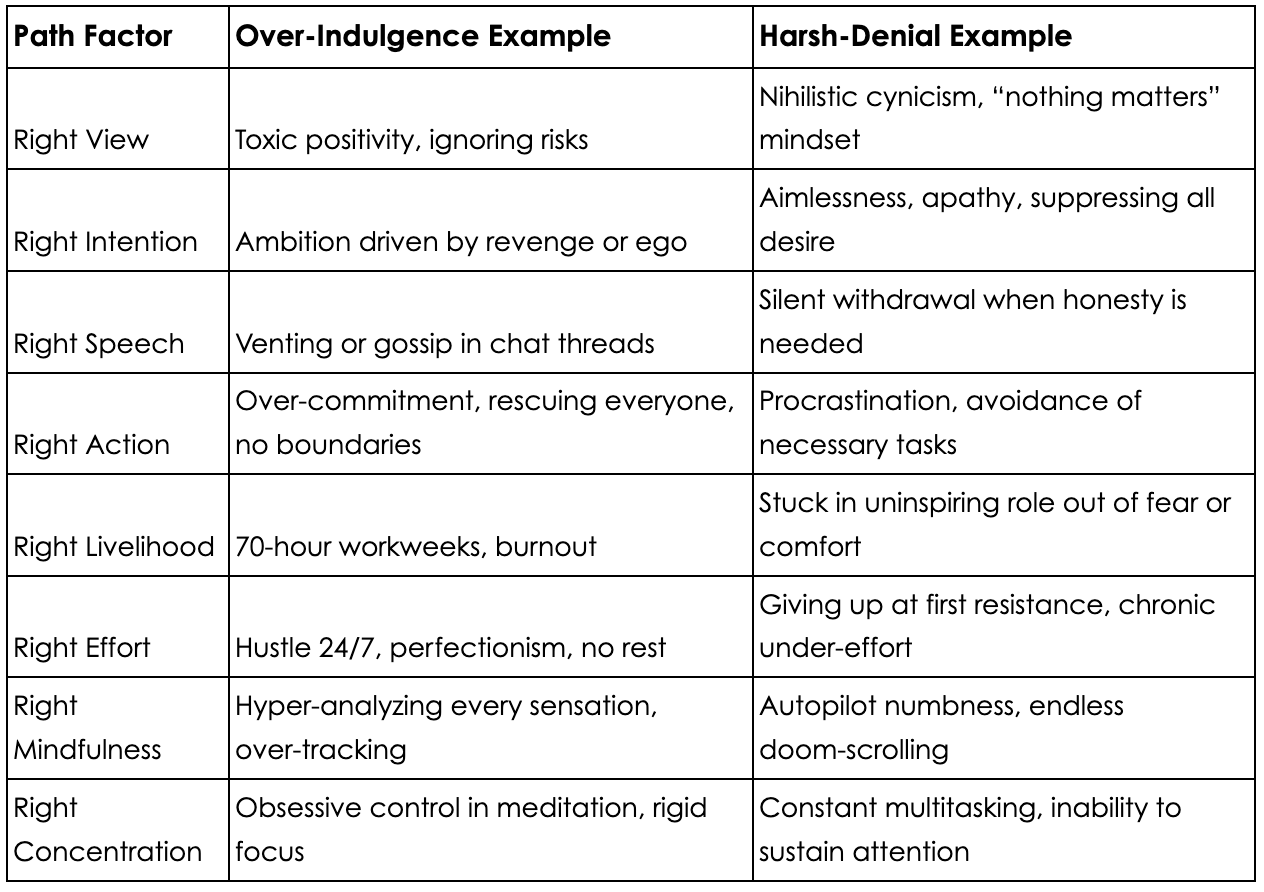
2. Write Your Extremes and Design Your Middle Way
Identify your extreme. Most people lean to one side rather than both. Observe yourself as a third person and the pattern will become clear. Next to each extreme, write a balanced alternative in an “I” statement that feels realistic right now.
Examples follow below:
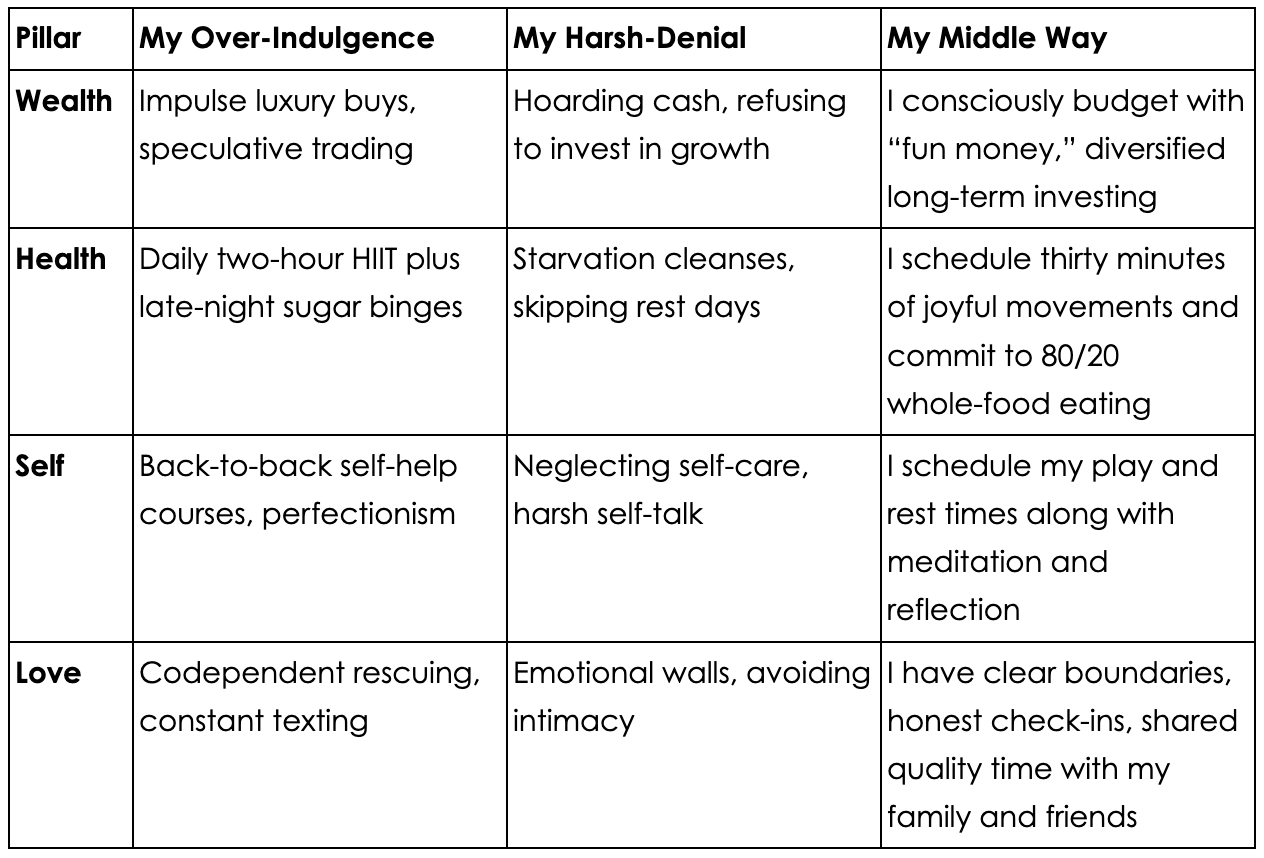
3. Give Yourself a Letter Grade
Grade each pillar A–F for how balanced it feels today.
4. Rank the Pillars
Rank 1–4 (use each number once):
1 = matters most to long-term peace, 4 = least.
5. Flag Urgent vs. Important
Most Urgent: Which pillar needs immediate attention because you may have been neglecting it?
Most Important: Which pillar will have the greatest impact on your lifelong well-being?
6. Craft Your Daily Middle Way Practice
Write one “I” statement in the present tense that you will practice daily.
Include how you will live the Eightfold Path in simple words.
Below Eightfold examples could assist you to arrive at some of your own. You can copy these Eightfolds below and put it in the worksheet.
Right View:
Right Intention:
Right Speech:
Right Action:
Right Livelihood:
Right Effort:
Right Mindfulness:
Right Concentration:
7. Noble Word
To create a baseline for your Middle Way practice, choose one word that instantly centers you.
Identify the driver.
Think about your biggest reactive pattern, often rooted in the family suffering.
Test opposites.
Try a few words that convey the opposite energy. Notice how each one feels in your body.
Choose the word that calms and steadies.
The right word should come from the heart, not the intellect.
My example:
I spent most of my life like a small animal outrunning a tiger. Hyper-alert, high-performing on four hours of sleep, driven by survival energy. Words like “relax” felt impossible, thus making me more anxious. I tried “easy-going” this year. That felt like mediocrity, which angered me; after working so hard for so many years, I didn’t want to be a mediocre, easy-going, I-don’t-care person. Then I found “soft.” When I soften my thoughts, words, emotions, and actions, it eases my tension and breath, brings me a notch down, and places me in the Middle Way while performing as my higher self.
I hope you follow the same process and discover your own word that shifts you into your Middle Way.
8. A Few Thoughts to Ponder
The 8-minute Rule: When you’re going through a hardship, you only need 8 minutes from a friend to be comforted.
Love rope = human rope
A rope is anything that binds or ties things together. In our inner life, a rope symbolizes emotional attachment. Love rope = human rope reminds us that the powerful ties of love are made of the same “material” as all other human attachments. The rope itself is neutral; the way we hold it determines whether it supports us or restricts us.
Held lightly and mindfully, it connects us with warmth and care.
Gripped too tightly, it becomes a fetter that fuels worry, jealousy, or suffering.
In practice, the goal is not to cut the rope but to loosen our grip, loving without clinging, connecting without losing our freedom.